
|
 |
Citroën CX GTi
|
Autocar
15th October 1977
|
The fastest, most powerful CX yet.
Incorporating Bosch L-jetronic petrol injection and five-speed
transmission.
Good, safe handling and excellent ride comfort.
A superb car, let down by rather poor ventilation.
|
|
EVER
SINCE the appearance of the corrugated-iron 2CV immediately after the
War, it would be fair to say that Citroën have never built a
conventional car. Indeed, in many ways, Citroën have done everything
that was, at the time, against all engineering tradition.
In 1955,
they stood the motoring world on its head with the introduction of the
ID/DS range, a car which was said to be 10 years ahead of its time.
Now, some 22 years later, no other manufacturer has quite caught up
with the French revolution.
The CX, which appeared, in its 2-litre form, in 1974, was not perhaps
such a surprise. Although its long, smooth shape continues in the DS
tradition, it was nothing like as startling as the SM. With the new
car, Citroën were able to pick the best of the bunch from their
previous ideas. Naturally, front-wheel drive was retained, but the
engine was transverse, canted forward, with the transmission behind it.
The oleo-pneumatic, self-levelling suspension was retained, and the
self-centering, power steering came from the SM.
|
 |
|
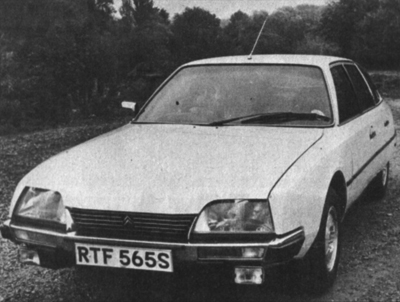
In May of this year, the GTi was launched in continental
Europe, and last month it became available in Britain. The engine, with
bore and stroke dimensions of 93.5 X 85.5mm, is one of the largest
four-cylinder units in use today, with a capacity of 2,347 c.c. The
biggest change is the use of petrol injection in place of the
twin-choke Weber used on the normal CX2400; the system is Bosch's
L-jetronic, electronically controlled. This, with a marginal increase
in compression ratio from 8,75 to 9.10-to 1, brings about an 11.5 per
cent increase in power, from 115 bhp (DIN) at 5,500 rpm to 128 bhp,
developed at only 4,800 rpm. Torque too is up, by 10 per cent, to a
useful 145 lb.ft. at 3,600 rpm. To maintain tune and to reduce
servicing costs, the GTi is fitted with contactless electronic ignition.
|
 |
|
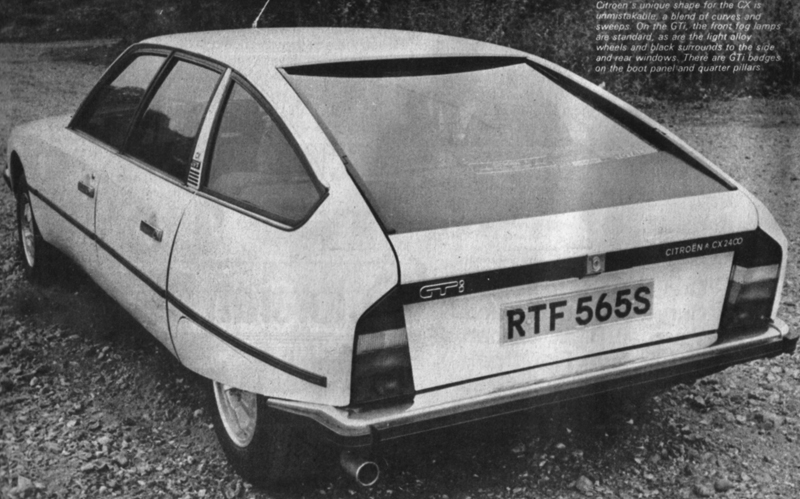
There
are major changes, too, in the transmission. The four-speed, manual
gearbox of the carburettor-engined car is replaced by an all-indirect,
five-speed one; the tyre size and sections are unchanged, using
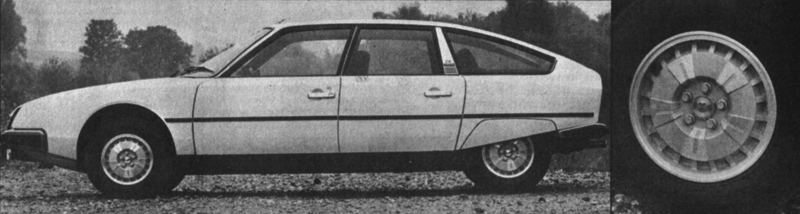
Michelin XVS 185HR14 covers, but mounted on lightweight alloy wheels.
First gear is marginally lower than on the carburettor car (3.17
compared to 3.1 5-to-1) but top is now a true overdrive, pulling
21.1mph per 1000 rpm on the same 4.77-to-1 final drive ratio. This high
gearing means that the GTi tends to be far more' comfortable when
cruising really fast on motorways, but even so, at the mean maximum
speed of 118 mph the revs are well past the peak of the power curve, at
nearly 5.600 rpm.
Front-wheel-drive cars always tend to look and sound slightly
“hooligan" when moving off under full power but, with its big section
tyres, the GTi managed to retain some of its dignity, with just a few
yards of wheelspin when the clutch was engaged at around 3,500 rpm.
The extra power and torque by comparison with the CX2400 show up
immediately in terms of times taken in acceleration, with 40 coming up
in 5.1sec against 5.8sec, 60 in 1O.1 (11.8)and 80 mph in 18.2 sec, 2.8
sec better than the CX2400.
It took a certain amount of experimenting to get best times for with
the power being developed low in the rev range, there was a tendency to
hang on in the gears up to the 6,000 rpm red line. We eventually
settled for changing at 5,500 rpm. The difference is shown by the times
recorded - 10.1 sec to 60 mph changing at 5,500, against 10.6sec at
6,000 rpm. But the really "remarkable feature about the GTi is the
extraordinary flexibility of the engine especially when it is
remembered that it has only four cylinders.
In top (fifth) gear it would pull away cleanly from 20mph - that is
under 1,000 rpm - without any fuss. This is a real credit to the
combination of engine design and the and the efficiency of the
L-jetronic injection.
In the lower gears, the GTi will reach 29, 51, 74 and 99 mph at 6,000
rpm, these figures are rather academic, however, as it pays to change
up 500 rpm earlier, no matter what the circumstances.
|
 |
|
Ride and handling
There
can be little doubt that, for the first few days of ownership, the GTi
can be a rather disconcerting car to drive. The VariPower steering
seems to have a mind of its own, the brake pedal no apparent travel,
and the drive line can snatch and jerk. It takes time to come to terms
with it, but once you have altered your method of driving, the GTi
becomes a thoroughly rewarding car to use.
There are just 2.5 turns
from lock to lock on the steering, which has power self-centering.
Newcomers will drive the car in a series of lurches, until they realize
that it must be steered every inch of the way, Let the steering wheel
run back of its own accord on the exit from a corner and it will snap
back to the centre position. But if the wheel is fed back smoothly, the
car responds in a similar manner and one soon learns the technique
required for comfortable driving.
The GTi has very nearly 70 per cent of its 26,8 cwt over the front
wheels, and this gives it inherent understeer characteristics. The
power steering gives just the right amount of assistance, so that it
feels heavier as more lock is applied. This in turn gives the driver a
good sense of the understeer and prevents the car from being put into
attitudes from which it cannot recover. The steering is also
speed-sensitive, with less assistance being given the faster the car is
travelling. On motorways, this means that it feels very heavy but, as
you never want to turn at right angles at this sort of speed, it gives
the car a very high degree of stability. We have found that all the CX
range tend to wander very slightly at speed; left to their own devices,
they are happy, but if the driver tries to correct, a weaving motion
will set in.
The original oleo-pneumatic, self-levelling suspension system used on
the DS has been considerably refined and is no longer, as we once
described it, "heave and sigh for the open road .... " The ride comfort
is good, with ample wheel and spring movement to absorb humps,
undulations, and potholes with ease. Yet the damping effect is on the
firm side, which cuts out any tendency to wallow or pitch. It is only
on coarsely-surfaced roads (concrete sections of motorway especially)
that any harshness is transmitted into the passenger compartment.
Running over cats' eyes will also produce a sharp bang.
Between the front seats is a control to adjust ride height. There are
two "on the move" positions: normal and high. The very high,
wheel-changing position can be used at low speeds on very rough tracks.
|
 |
Fuel consumption
Our
fuel measurement equipment does not yet allow us to tackle cars with
petrol injection but, overall, the GTi returned 21.6 mpg, compared with
the 23.5 mpg of the CX24OO carburettor car which we tested in July of
this year. Our best figure, using the car for normal running about and
keeping off motorways and high-speed driving, was 23.1mpg, while a
really fast run dropped the brim-to-brim figure to 19.4mpg. So, with
reasonable use, the 15 gallon tank should give a range of about 320
miles. A good feature is that the fuel filler has a big neck, so there
is no blowing back.
Brakes
Full
power braking, using the high-pressure hydraulic system which also
serves the suspension and steering, is used on the CX GTi. As we said
earlier, this tends to be a bit disconcerting at first because the
pedal has hardly any travel. A progressive spring bias is built in to
give the feel. Pressures are light, with just 20lb needed for check
braking and 50lb giving a maximum of 0.95g. Because the CX GTi has
anti-dive suspension the nose does not dip, even under heavy braking,
and this can give the impression that the brakes are not working
properly.
From cold there is a tendency for some initial fade, but this
stabilizes after five stops from 70mph at 0.5g
The parking brake works, unusually, on the front discs, using its own
separate pads. With so much weight over the front wheels it is highly
effective, giving O.45g, which means that it could be useful in an
emergency. It held the car easily on the 1-in-3 hill, from which it was
able to move off again with just a scrabble of front wheelspin.
|
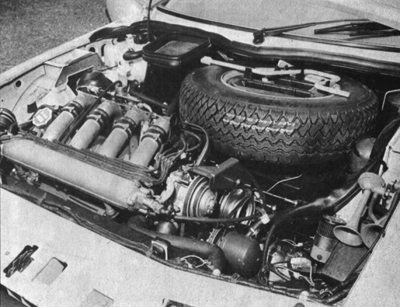
Above
despite the apparently packed underbonnet area, access around the
transverse engine is fairly goo.
The injection control equipment is behind the four induction pipes.
The rectangular unit to the left of the spare wheel is the
heater/ventilation air intake.
The wheel changing equipment is stowed on top of the spare, with the
central hydraulic reservoir tucked in the right-hand rear corner of the
bonnet opening.
The bonnet is propped open by an over-centre strut. |
 |
|
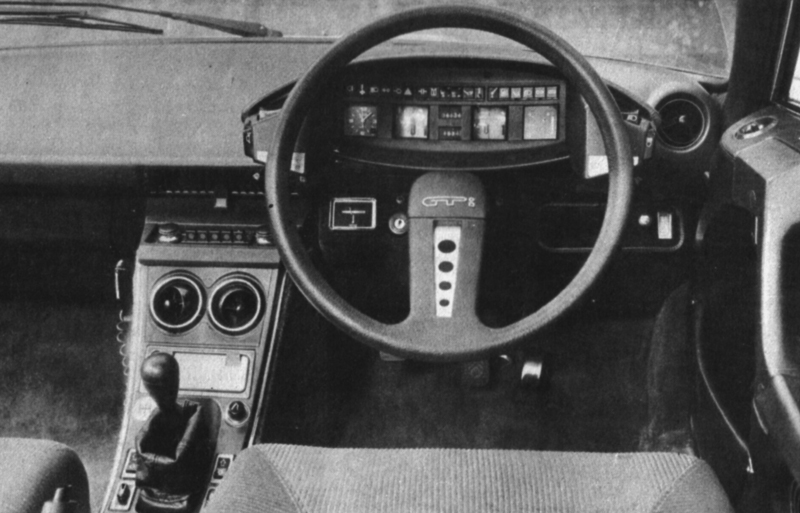
Fittings and comfort
Like
the rest of the car, Citroën like to be different from everyone else
when it comes to the interior. They have managed to break away from the
traditional layout; their facia panel looks more like a piece of modern
sculpture than the product of a car factory.
In their own perverse
way, they have also stuck to their rotating drum speedometer and rev
counter. While these may fit the company's futuristic image, they
cannot be read quickly; dials with needle pointers would be very much
better. For the fuel gauges and voltmeter, vertical scale displays are
used; the fuel gauge is not a hot wire type, and lurches up and down in
corners or under acceleration. The GTi has the usual CX press-button
oil level sight glass tucked away beneath the right-hand side of the
facia, and only this model has the temperature gauge on the opposite
side.
The main controls and switches are carried on two "horns" which flank
the instruments and are within finger-tip reach when the hands are on
the steering wheel. The group on the left include a rocking switch for
the indicators which, as in all Citroëns, are not self-cancelling. A
loud repeater and clear warning lamp ensure that the driver does not
forget, and after a few miles one starts to appreciate this system.
Beneath the indicators is the wiper switch with intermittent sweep
position. All the CX range have a single, huge blade, pivoted
centrally. This is effective enough up to about 70mph, but beyond that
there is a tendency for it to lift off at the top of the blade, right
in the driver's line of vision. A light pressure on the horn button
produces a polite noise; more pressure and a pair of strident air horns
join in. On the opposite side, matching switches control the headlamp
dip/main beam, main lighting switch and the headlamp flasher.
The headlamps are not particularly good, producing a woolly pattern. On
dip beam and a rather uncontrolled blast of light on main beam. On the
GTi, a pair of very effective front foglamps are standard, as are the
built-in rear foglamps, controlled by press-button switches hidden away
under the control panel. Lighting for the speedometer and rev counter
comes on with the ignition, the remainder of the instrument lighting
being controlled by the main lighting switch. A dimmer controls the
intensity.
A central console carries the radio (an extra), ashtray and cigarette
lighter, controls for the electric front windows, and press button
switches for the heated rear window and really good interior lamp.
Tucked between the seats, alongside the suspension height control, are
the group of three heater and ventilation controls.
For a car which started on a virtually clean sheet of paper, the
ventilation is something of a disappointment. There is little ram
effect, and the blower is needed virtually all the time. A water-valve
heater control is used, and this takes a long time to respond, so that
it tends to be difficult to achieve a comfortable climate within the
cabin.
To complement the excellent ride, the seats in the GTi are very
comfortable, trimmed in a wide-ribbed corduroy material. For the
driver, the seat cushion can be adjusted for tilt, while both front
seats have reclining backrests, although the lever controls do not give
the same precise adjustment that can be achieved with a wheel control.
If there is criticism, it is that there is not quite enough lateral
support from the backrests. At the sort of speeds at which the GTi can
be cornered the driver tends to have his body rolled off the seat. Head
restraints are standard, with soft, clip-on cushions.
Rear-seat passengers have ample head and leg room, with a drop-down
armrest to provide some extra location. The seating is again very
comfortable. The rear windows are controlled by normal handles, and the
doors are fitted with childproof catches. Neither front door can be
slam locked and a separate key is used for these and the boot.
Visibility is really superb and, despite the long, sloping bonnet line,
which disappears from the driver's vision, the GTi is really a very
easy car to place. The pillars are slim and the quarter window, behind
the rear passengers, ensures that there are no serious blind spots.
Noise levels too are low, with a gentle rush of wind over the smooth
lines. Under full-throttle acceleration, the big four-cylinder engine
tends to be a bit thunderous, yet even this noise is subdued once
cruising speed has been reached and held.
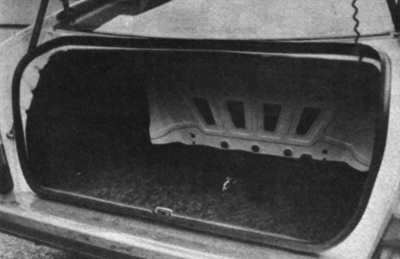
Boot space is generous, and the almost-vertical rear panel lifts well
clear to make loading easy. With the spare wheel and jacking equipment
stowed away under the bonnet, the space is totally uncluttered. An
interior lamp is provided and there is the additional light, with the
parking lamps on, from the number plate lamps, which have a window in
the rear of their housings.
Under the bonnet, the transverse engine and its neat layout of petrol
injection equipment is fairly easy to work on, and the spare wheel,
stowed flat at the rear of the compartment, does not need to be
removed. But getting it out is quite a job, and care has to be taken
not to knock off the various electrical connectors which surround the
wheel.
The only slightly difficult item to check is the battery, buried in the
left-hand front wing, ahead of the wheel. The "heart" of every CX is
the high-pressure pump for the hydraulic supply, but this is located so
that changing the drive belt is a very simple task.
|
| SPECIFICATION |
| ENGINE |
Front, front wheel drive |
| Cylinders |
4, in-line transverse |
| Main bearings |
5 |
| Cooling |
Water |
| Fan |
Electric |
| Bore mm (in) |
93.5 (3.68) |
| Stroke mm (in) |
85.5 (3.37) |
| Capacity cc (cu. in) |
2,347 (143) |
| Valve gear |
ohv |
| Camshaft drive |
Chain |
| Compression ratio |
9.1 to 1 |
| Octane rating |
98 RM |
| Injection |
Bosch L-jetronic |
| Max power |
128 bhp (DIN) at 4,800 rpm |
| Max torque |
145 lb. ft. at 3,600 rpm |
| TRANSMISSION |
|
| Type |
Five speed, all-synchromesh |
| Gear |
Ratio |
mph/1000rpm |
| Top |
0.73 |
21.1 |
| 4th |
0.94 |
16.5 |
| 3rd |
1.25 |
12.4 |
| 2nd |
1.83 |
8.5 |
| 1st |
3.17 |
5.0 |
|
| Final drive |
Helical spur |
| Ratio |
4.77 to 1 |
| SUSPENSION |
|
| Front |
Double wishbones |
| Springs - dampers |
Hydropneumatic units |
| Anti-roll bar |
Yes |
| Rear |
Trailing arms |
| Springs - dampers |
Hydropneumatic units |
| Anti-roll bar |
Yes |
| STEERING |
|
| Type |
Rack and pinion with power self-centering |
| Power assistance |
VariPower |
| Wheel diameter |
15.0 in |
| BRAKES |
|
| Front |
10.24 in dia. disc |
| Rear |
9.20 in. dia. disc |
| Servo |
Hydraulic |
| WHEELS |
|
| Type |
Light alloy 5 studs |
| Rim width |
5 1/2 in. |
| Tyres - make |
Michelin XVS |
| Tyres - type |
Radial ply tubeless |
| Tyres - size |
185HR14 |
| EQUIPMENT |
|
| Battery |
12 volt 60Ah |
| Alternator |
80 amp |
| Headlamps |
Halogen 90/190watts total |
| Reversing lamp |
Standard |
| Hazard warning |
Standard |
| Electric fuses |
4 |
| Screen wiper |
2 speed, plus intermittent |
| Screen washer |
Electric |
| Interior heater |
Water valve |
| Interior trim |
Cloth seats, PVC headlining |
| Floor covering |
Carpet |
| Jack |
Screw pillar |
| Jacking points |
4 under sills |
| Windscreen |
Laminated |
| Underbody protection |
Paint and wax |
| MAINTENANCE |
|
| Fuel tank |
15.0 Imp gal (68 litres) |
| Cooling system |
18.5 pints (inc heater) |
| Engine sump |
8.2 pints SAE 20W/50 |
| Gearbox and final drive |
2.8 pints SAE 80EP |
| Greasing |
No points |
| Valve clearance |
Inlet 0.006 in (cold) |
|
Exhaust 0.008 in (cold) |
| Contact breaker |
Electronic ignition |
| Ignition timing |
25 deg BTDC (at 2,500 rpm) |
| Spark plug - type |
Champion L87Y |
| Spark plug - gap |
0.025 in |
| Tyre pressures |
F 30 R 32 psi (normal driving) |
| Max payload |
1,025 lb (466 kg) |
|
WEIGHT
|
Kerb. 26.8 cwt/3,000 lb/1,364 kg
Distribution F/R 69.5/30.5
As tested 30.0 cwt/3,361 lb/1,528 kg |
| Boot capacity |
16.8 cu ft |
| Turning circles: |
|
| Between kerbs |
L 35 ft 9 in R 35 ft 4 in |
| Between walls |
L 38 ft 8 in R 38 ft 4 in |
| Turns lock to lock |
2.5 |
|
| Maximum Speeds |
| Gear |
mph
|
kph
|
rpm
|
| Top (mean) |
118
|
190
|
5,590
|
| Top (best) |
117
|
188
|
5,545
|
| 4th |
99
|
159
|
6,000
|
| 3rd |
74
|
119
|
6,000
|
| 2nd |
51
|
82
|
6,000
|
| 1st |
29
|
47
|
6,000
|
|
| Acceleration |
|
True mph
|
Time (sec)
|
Speedo mph
|
|
30
|
3.5
|
28
|
|
40
|
5.1
|
40
|
|
50
|
7.4
|
51
|
|
60
|
10.1
|
61
|
|
70
|
13.7
|
72
|
|
80
|
18.2
|
82
|
|
90
|
24.3
|
92
|
|
100
|
34.4
|
103
|
|
110
|
-
|
114
|
|
| Standing 1/4 mile |
17.4 sec, 75 mph |
| Standing kilometre |
32.3 sec, 97 mph |
|
mph
|
Top
|
4th
|
3rd
|
2nd
|
|
10-30
|
-
|
8.8
|
5.9
|
3.8
|
|
20-40
|
10.9
|
7.8
|
5.4
|
3.6
|
|
30-50
|
10.9
|
7.5
|
5.1
|
3.9
|
|
40-60
|
11.0
|
7.8
|
5.0
|
-
|
|
50-70
|
11.6
|
8.3
|
6.4
|
-
|
|
60-80
|
11.7
|
10.8
|
-
|
-
|
|
70-90
|
13.4
|
-
|
-
|
-
|
|
80-100
|
15.7
|
-
|
-
|
-
|
|
|
CONSUMPTION
|
| Fuel |
Autocar formula |
| Overall mpg: 21.6 |
Hard driving, difficult conditions |
| (13.1 l/100 km) |
19.6 mpg |
Calculated DIN mpg 21.2
(13.4 l/100 km) |
Average driving, average conditions |
| Constant speed: |
23.8 mpg |
| Measuring equipment not |
Gentle driving, easy conditions |
| compatible with petrol injection |
28.1 mpg |
Grade of fuel: Premium,
four star (98 RM)
Mileage recorder: 3.0 per cent
over-reading |
|
BRAKES
|
Fade (from 70 mph in
neutral)
Pedal load for 0.5g stops (lb) |
|
start/end
|
start/end
|
|
1
|
25/25
|
6
|
40/50
|
|
2
|
30/35
|
7
|
40/50
|
|
3
|
35/40
|
8
|
40/55
|
|
4
|
35/40
|
9
|
40/55
|
|
5
|
40/50
|
10
|
40/55
|
|
| Response from 30 mph
in neutral |
Load
(lb) |
g |
Distance
(ft) |
| 20 |
0.35 |
86 |
| 30 |
0.55 |
55 |
| 40 |
0.72 |
42 |
| 50 |
0.95 |
32 |
| Handbrake |
0.45 |
67 |
| Max gradient: 1 in 3 |
|
|
CLUTCH
|
| Pedal 40lb and 5 1/2 in |
|
TEST
CONDITIONS
|
| Wind |
4 - 10 mph |
| Temperature |
13 deg C (55 deg F) |
| Barometer |
29.8 in Hg |
| Humidity |
72 per cent |
| Surface |
Damp asphalt and concrete |
| Test distance |
1,137 miles |
|
REGULAR
SERVICE
|
|
Interval
(miles)
|
| Change |
3,000
|
6,000
|
12,000
|
| Engine oil |
Yes
|
Yes
|
Yes
|
| Oil filter |
-
|
-
|
Yes
|
| Gearbox |
-
|
-
|
Yes
|
| Spark plugs |
-
|
-
|
-
|
| Air cleaner |
-
|
-
|
Clean
|
| Total cost |
£5.62
|
£10.57
|
£31.95
|
|
|
PARTS COST
|
|
(including VAT)
|
| Brake pads (2 wheels) front |
£16.90
|
| Brake pads (2 wheels) rear |
£11.55
|
| Exhaust system |
£83.58
|
| Tyre - each (typical advertised) |
£46.22
|
| Windscreen |
£136.48
|
| Headlamp unit |
£42.98
|
| Front wing |
£42.07
|
| Rear bumper |
£66.29
|
|
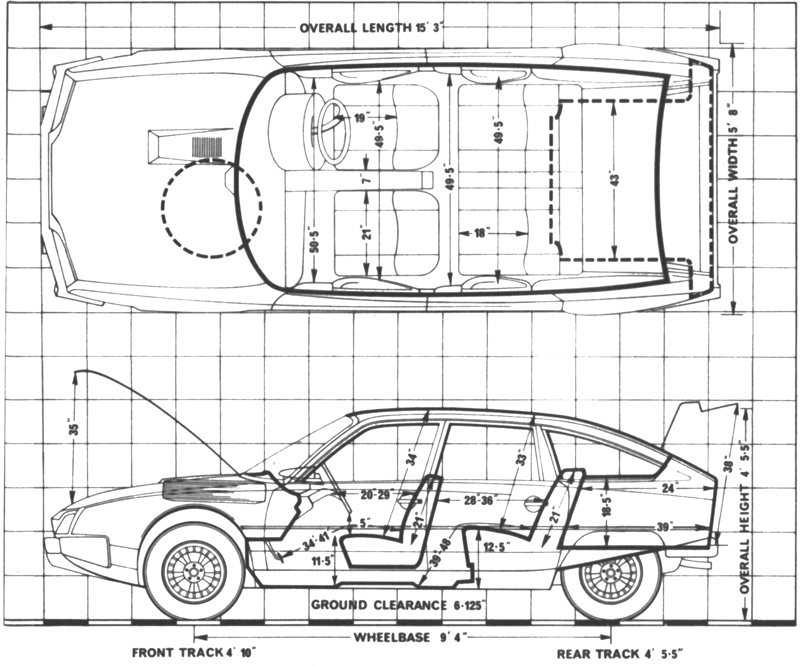 |
| Comparisons |
Price
(£) |
Max mph |
0-60
(sec) |
Overall mpg |
Capacity
(c.c.) |
Power
(bhp) |
Wheelbase
(in) |
Length
(in) |
Width
(in) |
Kerb weight
(cwt) |
Fuel
(gal) |
Tyre size |
| Citroën CX GTi |
6,530 |
117 |
10.1 |
21.6 |
2,347 |
128 |
112.0 |
181.0 |
68.0 |
26.8 |
15.0 |
185HR14 |
| Audi 100-5E |
5,599 |
109 |
11.8 |
23.3 |
2,144 |
136 |
105.5 |
184.5 |
69.5 |
23.5 |
13.2 |
185/70-14 |
| Lancia Beta 2000 |
4,513 |
110 |
10.1 |
24.0 |
1,995 |
119 |
100.0 |
169.0 |
66.5 |
21.8 |
11.4 |
185/70-14 |
| Princess 2200 HLS (A) |
4,320 |
98 |
14.2 |
21.8 |
2,227 |
110 |
105.0 |
175.5 |
68.0 |
23.9 |
16.0 |
185/70-14 |
| Renault 30TS (A) |
6,185 |
111 |
11.7 |
20.2 |
2,664 |
131 |
105.0 |
178.0 |
68.0 |
25.5 |
14.7 |
175HR14 |
|
| Test Scorecard |
|
| (average of scoring by Autocar
Road test Team) |
|
| Ratings |
6 Excellent |
|
5 Good |
|
4 Above average |
|
3 Average |
|
2 Poor |
|
1 Bad |
|
|
|
| PERFORMANCE |
4.67 |
| STEERING AND HANDLING |
4.92 |
| BRAKES |
4.40 |
| COMFORT IN FRONT |
4.17 |
| COMFORT IN BACK |
4.00 |
DRIVERS AIDS
instruments, lights, wipers, visibility, etc. |
4.00 |
| CONTROLS |
3.75 |
| NOISE |
4.17 |
| STOWAGE |
3.67 |
ROUTINE SERVICE
under-bonnet access, dipstick, etc |
4.50 |
| EASE OF DRIVING |
4.36 |
| OVERALL RATING |
4.30 |
|
|
|
|
Where it fits in
At
£6,350, the GTi is the second most expensive CX in the range, which
starts with the 2000 Confort, at £4,461. The two 2400s are the Super
and Pallas, at £4,991 and £5,498, while the Prestige, the top model in
terms of trim, with metallic paint, tinted glass, air conditioning and
Citroën's own C-matic three-speed, semi-automatic transmission all
standard, runs out at £7,77O. C-matic is available as a £270 extra on
all the 2400s, except the GTi.
Conclusion
This
is the fastest of the Citroën CX range, a car perfectly capable of
being cruised all day long flat out, carrying its passengers in
near-perfect comfort. There can be little doubt that, as always, you
either get on with the Citroën way of life, or you do not; there is no
half-way house.
It takes time to learn your way about a CX, lf you
have never driven one before, do not be put off too quickly. In a world
where convention and standardization have been imposed on practically
everything we use, the GTi comes as a great gust of fresh air to blow
away the cobwebs.
|
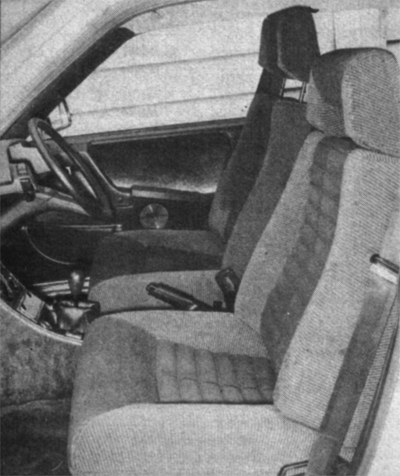 |
| Above: The front seats are very
comfortable, upholstered in a mixture of jersey and cord. The head
restraint cushions are detachable |
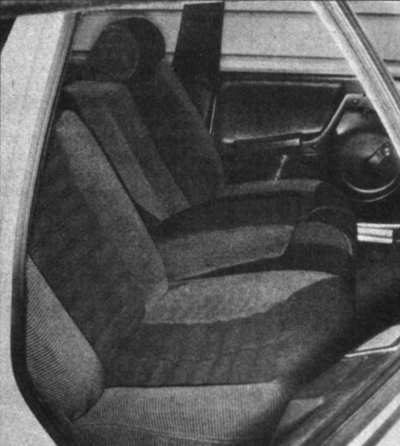 |
| Above: The rear seats have ample
head and leg room and the armrest gives good location |
|
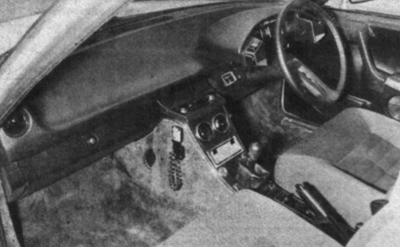 |
Above: In addition to the deep
door pockets, there is a locker with a drop down lid in front of the
passenger
Below right: The door mirror is
electronically adjustable by means of the small control on the sill |
 |
 |
| Above: This
neat map-reading light with a flip up magnifier has a built in switch |
|
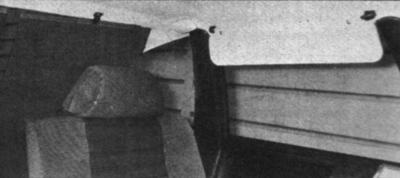 |
| Above: In bright sunshine or for
modesty perhaps, there are 'net' blinds behind the seats and sideways
mounted sun visors |
 |
|
MANUFACTURER:
Automobiles Citroën
133 Quai André Citroën, 75747
Paris, France
UK CONCESSIONAIRES
Citroen Cars Ltd
Mill Street, Slough
Buckinghamshire SL2 5DE
|
Above: With
the spare wheel and tools under the bonnet, the boot is free to take a
great deal of luggage. It has its own lamp and the sides and floor are
fully carpeted. The low sill makes it easy to load |
| Basic |
£5,427.00
|
| Special Car Tax |
£452.25
|
| VAT |
£470.34
|
| Total (in GB) |
£6,349.59
|
| Seat belts |
Standard
|
| Licence |
£50.00
|
| Delivery charges (London) |
£59.40
|
| Number plates |
£7.00
|
| Total on the road |
£6,465.99
|
| Insurance |
Group 7
|
| TOTAL AS TESTED ON THE ROAD |
£6,465.99
|
|
|
|
I emailed Autocar and asked
their permission to publish this article but they did not respond.
I assume therefore that they don't care. |
© 1977 Autocar/2011 Citroënët |
|













