|
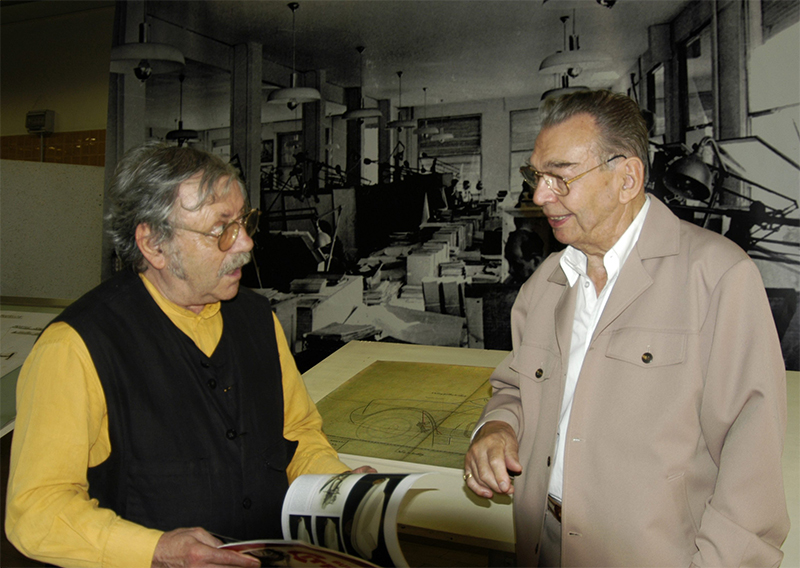
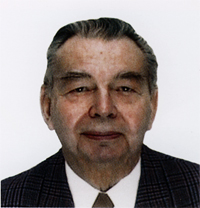
Henri Dargent contributed to
the long and glorious history of Citroën
Styling.
A talented model maker, he had
the privilege of being Flaminio
Bertoni's closest working partner
between 1957 and 1964
Forty years on, Henri Dargent
talks to "Double Chevron"
|
 |
|
Double Chevron: When did
you join Citroën?
Henri Dargent: My father was a
foreman at the Epinettes stamping workshop in
Paris and decided I was going to work for
Citroën. I joined the company in 1945 as part of
the André Citroën professional training
programme (FPAC).
D.C.: When did you meet
Flaminio Bertoni?
H.D.: The first time was at the
Grande Chaumière academy in Paris, where we were
working on drawing and sculpture from models. We
were introduced for the first time in 1949, at
an exhibition organised by the Association of
Citroën Artists. After spending some time in
central tooling, I started work at the design
office on the Rue du Théâtre in the 15th
arrondissement in Paris in 1953. 1 began working
with Mr. Bertoni in 1957, at his request.
D.C.: That must have been
a major event for you?
H.D.: Yes, it was really a major
event. I was going to work with a master. When 1
arrived he told me, 'This is a sculptors'
studio. You don't need your drawing board.'
D.C.: Why do you think he
chose you?
H.D.. While 1 was working in
Citroën's design office, I was also taking
classes in Applied Arts at the Arts et Métiers
engineering college. I wanted to further my
training and get a diploma in engineering. So I
decided to submit some of my vehicle projects to
Mr. Bertoni.
|
|
|
H.D.: He smiled and brushed them aside.
D.C.: What did you work
on in the Bertoni studio?
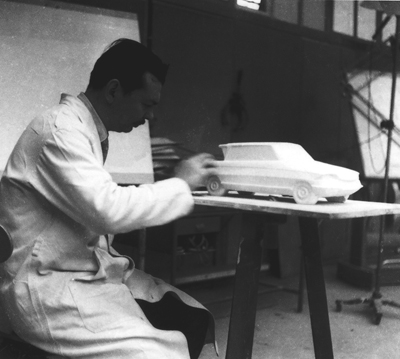
H.D.: Car models in plaster. We
made life size, scale 1 sculptures. We didn't
make many small models.
D.C.: Did he frequently
intervene, or did he let you get an with
things yourself?
H.D.: It depended, really. It was
a bit of an adventure. I would often leave a
model in a fairly advanced rough form at the end
of the day, and when I arrived the next morning
he'd be changing the model's volumes with his
little hammer!
D.C. : Bertoni made some
magnificent sketches, but the main image we
have of him today is that of the man working
on a model of the Traction Avant. He
pioneered 3D volume modelling. Was this the
most important form in his eyes?
H.D. : It's true that he made
sketches to define a part, but without going
into detail. Only volume counted. He had the
shape he wanted to make in his head, and it was
difficult to get away from it.
D.C.: What was it like
working with him?
H.D.: I admired him. I worked
incredibly hard, and I observed him to
understand how he arrived at the final result.
D.C.: Can you describe
his method?
H.D.: He shaped each model using a
plane, taking into account the way it caught the
light. And he stopped when the result seemed
satisfactory. It was sensual and instinctive
sculpture. But he also knew a great deal about
materials and steel. He always had a reason for
what he did, and he was extremely precise with
technical definitions. Don't forget that he was
a coachbuilder when he was younger. He knew all
about marking out and shaping metal. Bertoni was
a genius he was into everything, and he was a
real workaholic.
D.C.: And when you
presented projects to the management?
H.D.: With him it was a little
like improvised comedy. First, he presented the
models he liked the least, then, at the last
moment, he would say to me, 'OK Dargent, unveil
that one!' It was his way of getting the one he
liked accepted.
D.C.: Did he have any
influences?
H.D.: "He once confided to Robert Opron that
he'd rather go to the zoo than a motor show.
It's true that he sometimes drew his inspiration
from the shape of certain animals. The daring,
futuristic lines of the DS reflects the
"morphing" of a fish and a car. But 1 can assure
you that he paid close attention to other cars.
1 kept some of the notes and sketches he made at
the Paris Motor Show, and they clearly show he
was interested in various things. We're all
influenced by somebody. When Mr. Bertoni was
alone, he focused on himself. But as the team
got bigger, we all influenced each other. In
particular, I'm thinking about the work of Henriques Raba, who won the
Prix de Rome. We can also see Bertoni as the
gifted hand that was able to capture the
aerodynamic shapes André
Lefèbvre was looking for. He felt all of
these things instinctively rather than digesting
them in a scientific way. In my view, Flaminio
Bertoni was truly the greatest in terms of his
sensitivity and feeling for shape."
-
Robert Opron
- Head of Citroën Styling from 1964 to 1974.
-
Henriques Raba
- Citroën stylist from 1959 to 1962.
-
André
Lefèbvre - Manager of Citroën vehicle
styling in the early 1950s.
|
|
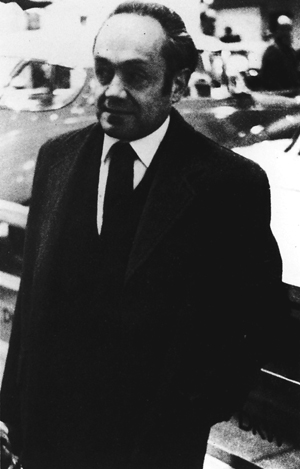
Flaminio
Bertoni (1903 - 1964)
The Traction Avant, the 2CV and the DS. These
three exceptional Citroën models owe their
existence to the genius and exceptionally
skilled hands of Flaminio Bertoni.
A born artist and a hard worker, Bertoni was no
doubt the first to sculpt body designs rather
than draw them, thus working on volumes more
than on lines.
People say that "il Maestro" created the body
of the Traction Avant "7" in one night in 1933.
He drew the 2CV at the end of the 1940s and
designed the famous "Hippopotamus" in 1947,
forerunner of the DS 19 released in 1955.
Three strokes of genius from one of the
forerunners of modern automotive styling.
|
 |