|
||||||||||||||
|
||||||||||||||














 |
||||
|
||||
| At a time when the marque was generally
pilloried by the majority of the UK automotive press, Car stood alone in its
appreciation of the double chevrons. |
||||
|
||||
|
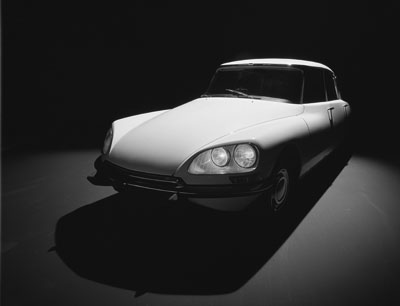
Considering the palliative powers of fuel injection, it’s surprising that Citroen didn’t get around to using it on the DS years ago. Even when the first D model appeared, back in the mid-1950s, it was generally agreed that the only fly in an extraordinarily advanced pot of ointment was the relatively retarded engine. Agricultural was the phrase that fitted it best. And in the decade and a half that has passed since, rising standards have continued to outstrip what small improvements Citroen could make. The trouble, then as now, is that it is a big, old fashioned, somewhat slow-revving four. The long term answer was clearly to throw it away and start again with something else, preferably the flat-6 that Citroen in pre-Maserati days were constantly rumoured to be on the point of introducing. But, of course, no such thing happened and finally, last September, Citroen succumbed to the attractions of fuel injection as a means of making a silk purse out of this sow’s ear. Would it be too cynical to suggest that the engineers were instinctively attracted by the prospect of having even more complication, further forests of pipes and tubes, in an engine compartment already jam-packed with paraphernalia? Whether or not that was their intention the result is that they have at last succeeded in making the engine entirely invisible beneath its canopy of ancillary items. The method used is an adaptation of the Bosch electronically controlled injection already used by, inter alia, Mercedes-Benz and Volkswagen. If fuel injection is to justify itself as an alternative to carburettors then it can do so only on a basis of near-perfect metering of petrol into the inlet tract. Electronic control of the amount and duration of each squirt must be more accurate than even the most sophisticated mechanical arrangement. |
|
|||
|
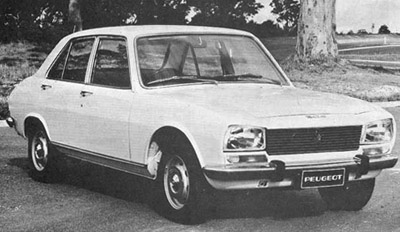
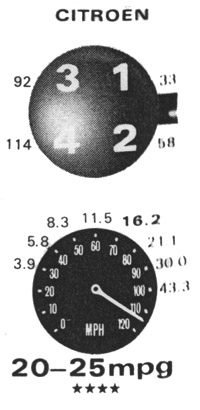
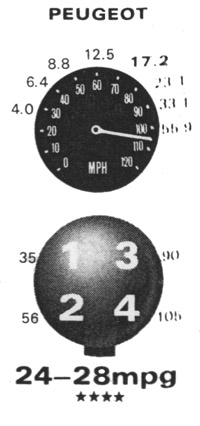
The Bosch system has sensors monitoring engine speed, coolant temperature, throttle opening and atmospheric pressure. The information is fed to a transistorised, printed-circuit control device - one hesitates to use the ‘miniature computer’ phrase that publicity men bandy about so freely - and this in turn is linked to the solenoid-operated injectors to control the timing of each stroke. The result is to push net bhp up by over 20percent from 106 to 125, which really is quite a reasonable figure for a crusty old 2.2 litre four like this one. Furthermore the peak of the power curve is moved down by 250 rpm to 5250. The improvement in torque, oddly enough, is considerably less marked, being less than 9 percent - it rises from 122lb ft to 135 - and is achieved at an unchanged 3500 rpm. The Bosch system is offered as an extra on the more splendid Citroens in the top of the range, starting with the DS21. We tried it on a DS21 Pallas. It adds £240 to the price in Britain, bringing it up to £2490. Or in other words a l0 percent price increase in return for 20percent more power. As a yardstick we also tried a Peugeot 504 with fuel injection. The system favoured at Sochaux is the Kugelfischer, as used on the 404 for years and by now thoroughly developed in its Peugeot application. A straightforward mechanical setup, its nozzles are aimed into the ports and are fed from a pump block mounted low down beside the canted engine. Specifying this instead of the standard single carburettor puts another £156 on the price, making it £1656. Maximum bhp (gross, since Peugeot don’t go in for the net variety) is a little over 20percent higher at 103 bhp, developed at 5600 rpm against 5500 with the carburettor. |
||||
|
||||
| ©1970 Car/Citroënët 2011 | ||||