|
More
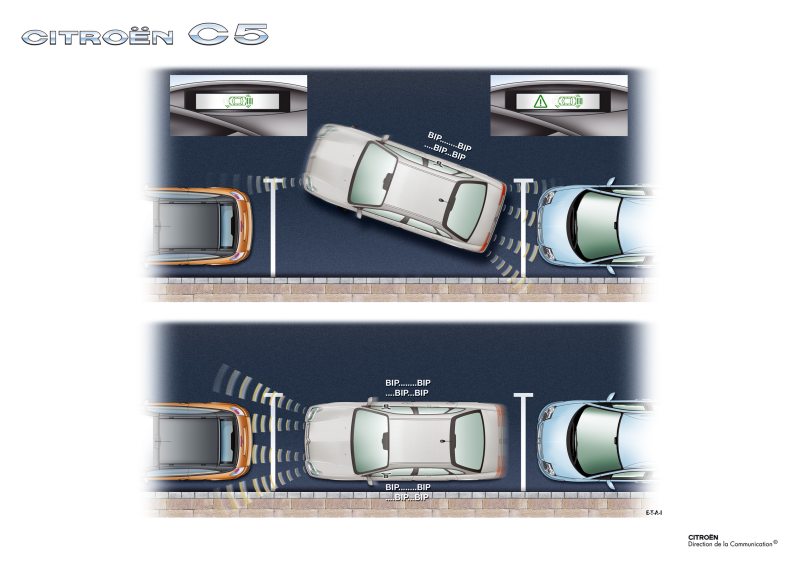
precisely, the system is activated during
manoeuvres in forward or
reverse gear at speeds of less than 10 kph. If
an obstacle is present
in the detection area, the sensors warn the
driver by means of a signal
emitted through the loudspeakers located at the
front or rear, left
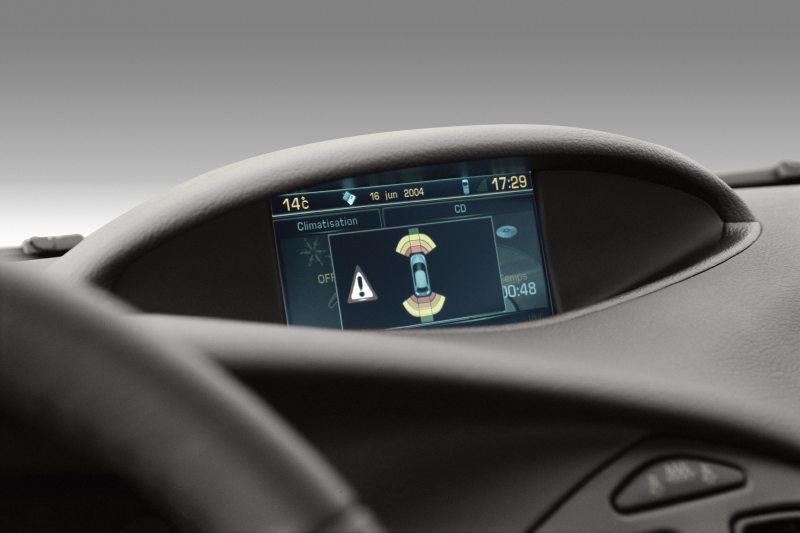
and/or right. At the same time, the silhouette
of the vehicle is
displayed on the multifunction screen, with
blocks corresponding to the
areas in which an obstacle has been detected.
Six different detection areas can be displayed
on the screen.
When
the car approaches an obstacle, the signal
indicates the obstacle’s
position through the oudspeakers located front
left or right or rear
left or ight in order to enable the driver to
locate it by ear.
The
closer the car comes to the obstacle, the faster
he bleeps. On the
multifunction screen, the blocks ove closer to
the front or rear
bumpers of the vehicle, and a warning triangle
indicating « CAUTION »
is displayed. At the same time, the sound signal
becomes continuous.
If
front and rear parking assistance is activated
when the driver puts the
car into reverse, a short bleep is emitted as a
warning. The silhouette
of the vehicle is displayed on screen.
If front parking
assistance alone is activated in forward gear,
and if vehicle speed is
non-zero or less than around 10 kph, in neutral
or with a gear
selected, the silhouette of the vehicle is
displayed on screen as soon
as an obstacle is detected at a distance of less
than 50 cm.
Parking
assistance can be deactivated using a button on
the central console.
The status of the function is memorised when the
vehicle stops.
Cruise control and a speed limiter for relaxed
driving
With
a view to making driving easier for customers
looking for comfort,
safety and well-being, the Citroën C5 is now
available with cruise
control and a speed limiter.
Cruise control maintains the
car at a programmed speed whatever the slope and
relief of the road
(within the limits of the engine brake and
engine power) without the
driver using the accelerator pedal.
The driver can modify
the programmed speed, if required, using the
control function behind
the steering wheel to accelerate or slow down.
The driver can also call
up the last speed registered since the function
was activated,
interrupt it temporarily or deactivate it
altogether.
The
general availability of cruise control is
accompanied by the
introduction of a speed limiter: the driver
chooses a maximum speed to
be respected at all times, whatever the position
of his foot on the
accelerator (within the limits of the engine
brake and engine power).
The speed limiter can be activated from 40 kph
for use in the city.
To
exceed this speed, in order to overtake for
example, the driver can
accelerate by pushing the pedal down hard to the
floor, and thus
override the hard spot marking the pedal
end-of-travel point.
The speed limiter is activated and programmed
in the same way as cruise control.
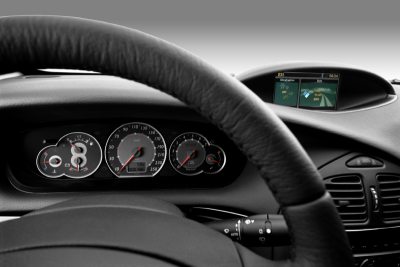
The instrument cluster shows the current speed
setting (cruise control / limiter) and system
status (active / inactive).
State-of-the-art engines
A concentrate of technology and innovation,
the Citroën C5 supplies the power necessary
for all types of driving.
Offering
a choice of six petrol and diesel engines, the
Citroën C5 covers a full
range of market requirements to strike an
ideal balance between
performance, reduced fuel consumption,
reliability and environmental
protection.
Petrol engines
· 1.8i 16V 117
bhp DIN at entry level
The
entry-level powerplant on the Citroën C5 is the
1.8 litre 16 valve
engine developing maximum power of 85 kW EEC
(117 bhp DIN) with torque
of 160 Nm at 4,000 rpm.
Responsive from the lowest engine
speeds, it is coupled with a five-speed manual
BE type gearbox.
Depending on the country, this powertrain may
meet with Euro III or
Euro IV emission standards.
· 2.0i 16V 143
bhp DIN and variable valve timing (VVT)
Among
the petrol engines available with the Citroën
C5, a new 2-litre
16-valve model (the EW10A) is launched in the
middle of the range.
This
2-litre 16-valve engine develops 103 kW EEC (143
bhp DIN) and torque of
200 Nm at 4,000 rpm. The top end of the engine
features variable valve
timing (VVT).
Making its debut on the Citroën C5, this
engine is coupled with the five-speed manual BE
gearbox, or the
four-speed auto-active sequentially controlled
AL4 type gearbox. This
powertrain meets the Euro IV emission standard.
· 3.0i V6 engine
and 6-speed automatic gearbox: smooth and
consistent performance
The
top of the range is covered by the 3.0i engine
(ES9A). Featuring a V6
layout with 24 valves, this engine is based on
the 3.0i V6, which is
also fitted on the C8.
It develops 152 kW CEE (210 bhp DIN) for
maximum torque of 285 Nm at 3,750 rpm.
This
exceptionally driveable revised engine offers
the smooth power specific
to a 6-cylinder powerplant. An engine of
consistent performance and
power, it can cope with all situations. These
qualities are largely due
to the new variable timing of the intake
camshafts.
The
continuously variable valve timing (VVT)
optimises filling of the
combustion chambers at all engine speeds, to
bring enhanced response
and driveability: two qualities that are
absolutely essential in a true
top-of-the range engine.
In terms of environmental
protection, the V6 engine complies with the Euro
IV emission standard.
It is coupled with the new sequential, automatic
six-speed AM6-type
gearbox.
Developed with AISIN A.W, this gearbox combines
a six-speed transmission with a high-torque
engine placed crosswise.
Basically, this gearbox uses the gear ratio
combinations of two epicyclic gear trains, one
single and one double.
The system is controlled by just five friction
components, managed by a compact integrated
control unit.
As a result, it is lighter and more compact
than any other six-speed gearbox to date.
Both
the weight and dimensions are comparable to
those of a four-speed
automatic gearbox, and better than those of
five-speed transverse
automatic transmissions with the same torque
capacity.
The
weight of the AM6 gearbox has thus been kept
down to 92 kg, a value
comparable, for example, with that of the
previous four-speed
4HP20-type gearbox.
The first ratio is shortened in order
to provide a high speed take-off. All six gear
ratios are designed to
make maximum use of the engine, with only a
slight fall in engine revs
at each gear change. This design optimises the
car’s acceleration
performance.
The sixth gear ratio gearbox has been choosen
to lower fuel consumption and also noise which
is already low.
The
AM6 gearbox offers a choice of two management
modes for enhanced
driving pleasure: automatic auto-adaptive mode
for stress-free driving,
and a more active sequential control mode.
The instrument cluster displays the programme
selected (auto-adaptive, sport or snow) or the
gear used (sequential mode).
For
increased safety, the gearbox features a
« shift lock » function to
prevent the driver shifting from the Parking (P)
position without also
applying the brakes. At the same time, a buzzer
sounds when the driver
opens the door without first placing the
gearlever in the Parking
position.
The new 3.0i V6 engine and new automatic
gearbox combine high-level performance with pure
driving pleasure.
Diesel engine
Dynamic and economical, the HDI engines – all
fitted with common-rail technology – offer
astonishing levels of performance.
The
new-generation common-rail injection system is
extremely precise for
improved efficiency. The recognised qualities of
these diesel engines
set them apart: reliability, response, torque
reserve from the lowest
engine speeds, acoustic comfort, low fuel
consumption and reduced
pollutant emissions.
Clearly, the Citroën C5 had to
provide a rich choice of diesel engine with, in
all cases, outstanding
torque for continuous driving pleasure on all
types of road.
· HDi 110 engine:
compact design, performance and technology
The
entry-level model of the Citroën C5 features the
HDi 110 engine with
the diesel particulate filter system (DPFS).
With a capacity of 1,560
cm3 and a 16-valve cylinder head, this engine is
coupled with a 5-speed
manual BE-type gearbox.
It develops 80 kW EEC (110 bhp
DIN) for torque of 240 Nm from 1,750 rpm.
Maximum torque can be
increased to 260 Nm through the overboost
function, which increases
turbo pressure for a short period.
Naturally, this engine also satisfies the Euro
IV emission standard.
The
combustion system of the HDi 110 engine features
the latest
technologies, with a second generation
common-rail injection system
offering maximum pressure of 1,600 bars.
This system is
coupled with multiple injection technology. The
main characteristic of
this system is that it can potentially manage
six successive injections:
· two
pre-injections to control combustion noise,
· two main
injections to obtain couple and torque, and
establish a good
noise/emissions/fuel consumption balance,
· if
required, two post-injections to regenerate the
DPFS.
Progress
in common-rail technology has brought lower fuel
consumption, greater
driving pleasure, enhanced acoustic performance
and fewer vibrations,
as well as ensuring a further reduction in
pollutant emissions.
To
extend its offering and meet the requirements of
diesel engines
customers, Citroën has decided to make the C5
available with two other
engines coupled with two distinct gearboxes.
Covering most market
requirements, these two engines make up the
heart of the range.
· HDi 138 engine
and 6-speed manual gearbox
The
2-litre HDi 138 16 valve engine develops 100 kW
CEE (138 bhp DIN ) for
maximum torque of 320 Nm at 2,000 rpm. The
overboost function increases
maximum torque to 340 Nm at 2,000 rpm at full
engine load.
This
engine is available with or without the Diesel
Particulate Filter
System (DPFS), depending on the country. The
DPFS version meets the
Euro IV emission standard.
The new-generation common-rail
direct injection system on the new HDi 138 is
supplied by Siemens. Like
the HDi 110, it is designed to manage up to six
different injections.
The system also delivers maximum injection
pressure of 1,600 bars.
This
engine is coupled with the new six-speed manual
ML6C gearbox, which is
designed to provide driving pleasure at all
times. Intermediate gear
ratios are optimised and the sixth gear offers
remarkable endurance on
the motorway.
· The HDi 136
DPFS coupled with an automatic gearbox : low
noise and high performance
The
Citroën C5 is also available with the 2.2 litre
HDi 136 16- valve
engine: a model of recognised qualities. An
engine of greater capacity
than the HDi 138 and of equally modern
architecture, the HDi 136 offers
high-level power and torque: 98 kW EEC (136 bhp
DIN) and 314 Nm at
2,000 rpm.
As a result, the C5 HDi 136 offers exceptional
performance and driving pleasure. These
qualities can also be
attributed to an array of advanced technologies,
including a variable
geometry turbo, an air-intake distributor with a
throttle valve for
variable swirl, two balancing shafts to limit
engine vibrations.
This
engine is associated with the four-speed
sequential automatic
4HP20-type gearbox. This combination gives the
Citroën C5 an
outstanding level of driving comfort. This
gearbox ensures that gear
shifts always fit the type of driving and the
road conditions.
Systematically fitted with the Diesel
Particulate Filter System, the HDi 136 satisfies
the Euro III emission standard.
· The Particulate
Filter (DPFS)
The
second-generation particulate filter traps the
particulates and burns
them as part of a process exclusive to the
common-rail system, using
the additive Eolys II. This innovative filter is
based on an advanced
strategy that reduces the frequency of filter
regeneration.
On
the HDi 138 and HDi 136 engines, the particulate
filters are now
replaced every 180,000 km, compared with 120,000
km previously.
A high level of active and passive safety
Safety
is more than a priority for Citroën, which has
endowed the C5 with a
generous range of equipment intended to assist
the driver and protect
the passengers.
New-generation ESP
To
give the Citroën C5 impeccable road manners and
ensure the safety of
the occupants in all circumstances, all versions
of this new vehicle
are fitted as standard with new-generation ESP
offering increased
computing power.
In difficult situations, a full range of
electronic driving aids take immediate action.
ABS
and electronic brakeforce distribution (EBD) are
completed by emergency
braking assistance to further reduce the
stopping distance. In the
event of a loss of grip, ESP automatically puts
the car back on course
and limits skidding of the wheels by means of
the ASR traction-control
system.
The ESP (electronic stability programme)
function
relies on a steering wheel sensor and a yaw
sensor to detect the first
signs of understeering or oversteering. The new,
more powerful control
unit sends out a command to correct the
understeering or oversteering,
applying adequate brake power on one or more
wheels, in individually.
In this way, the vehicle’s course is corrected
with greater precision
and accuracy.
The new ESP also includes a new function to
control partial braking when taking corners, and
a « brake pad drying »
function to optimise brake response in rainy
weather. Activation of
this system is linked to the wiper function and
has no impact on brake
wear.
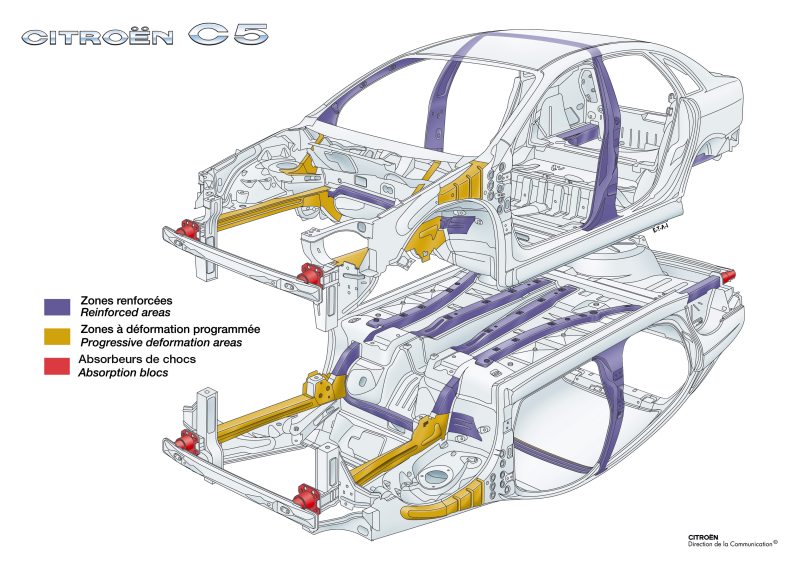
In terms of passive safety, the Citroën C5
features
efficient restraint systems for all the
occupant, together with a
structure designed to resist the most violent
impacts.
Seven airbags including a new
« knee » airbag
The
Citroën C5 is fitted as standard with two front
airbags (driver and
passenger), two front chest airbags and two
front/rear curtain airbags.
The two front airbags are adaptive: the
deployment pressure and volume
depend on the severity of impact. The passenger
airbag can be
deactivated using the ignition key, in order to
install a child seat at
the front. An indicator on the instrument
cluster informs the driver
that the airbag has been deactivated.
Drivers of the
Citroën C5 can also rely on a new steering
column airbag, a feature
that is fairly rare at present, even in segments
further up the market.
In the event of impact, this airbag protects
the driver’s knees and shins from the steering
column.
Efficient seatbelts
A range of equipment provides the driver and
passengers with close protection adapted to the
severity of possible impact.
On
the Citroën C5, the front seatbelts are equipped
with pyrotechnic
pretensioners and force limiters, with two
pyrotechnic pretensioners
for the passenger seatbelt. This feature holds
the occupant more firmly
in the seat and thus absorbs sudden deceleration
more effectively. At
the rear, the side seatbelts are fitted with
force limiters.
All
the belts are fitted with a warning sensor, very
useful when carrying
children, for example, and a presence detection
system for the front
passenger seat. To alert the driver and
passengers, the three seatbelt
warning lights are positioned in the centre of
the dashboard in order
to make the readout more visible. Moreover, if
seatbelts are not
attached, a buzzer sounds as soon as the vehicle
reaches a speed of 15
kph.
Seats: making safety and comfort
indissociable
The
studies conducted on seat design played a key
role in optimising
comfort and safety. In addition to offering
excellent support, the
seats of the Citroën C5 provide close
protection. The passenger seat
frame is reinforced to limit the impact of
submarining in the event of
impact. At the rear, the two side seats are
equipped with Isofix anchor
points.
Comfort worthy of a high-spec
vehicle
The concept of interior space takes on
new proportions
Looking
beyond the high standards set by the Citroën
C5 in terms of styling and
innovative equipment to enhance safety and
driving pleasure, the car
also features a level of interior comfort
worthy of the next segment
up, particularly in terms of acoustics.
This
comfort is also reflected in the spacious
passenger compartment and
generous boot volume – particularly in the
estate version – thus
placing the C5 one step ahead of the
competition.
A spacious interior
The
Citroën C5 is aimed at customers who have
stringent requirements in
terms of interior space. It seeks to satisfy
their requirements through
interior dimensions that are more than generous
for a vehicle in this
segment. No compromises were made in the design
of the welcoming
passenger compartment, which features generous
head room, remarkable
space at the front, and an exceptionally
spacious passenger area at the
rear, combined with a flat floor.
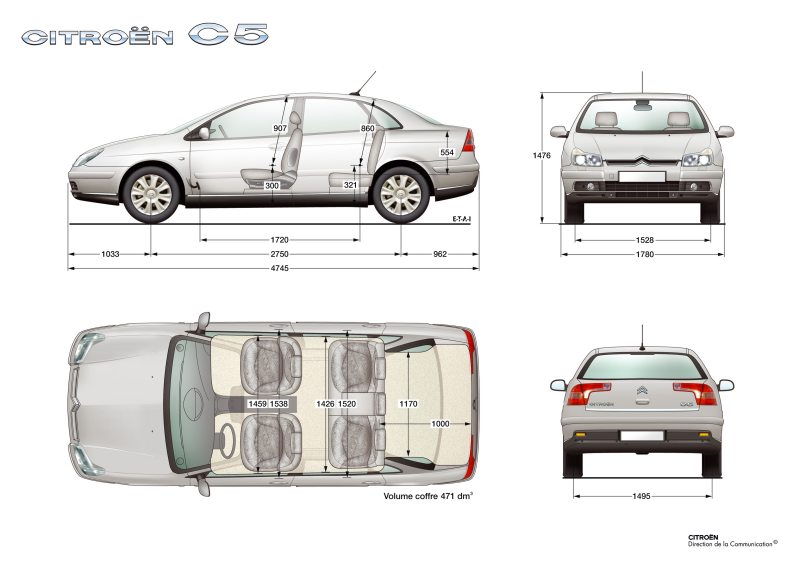
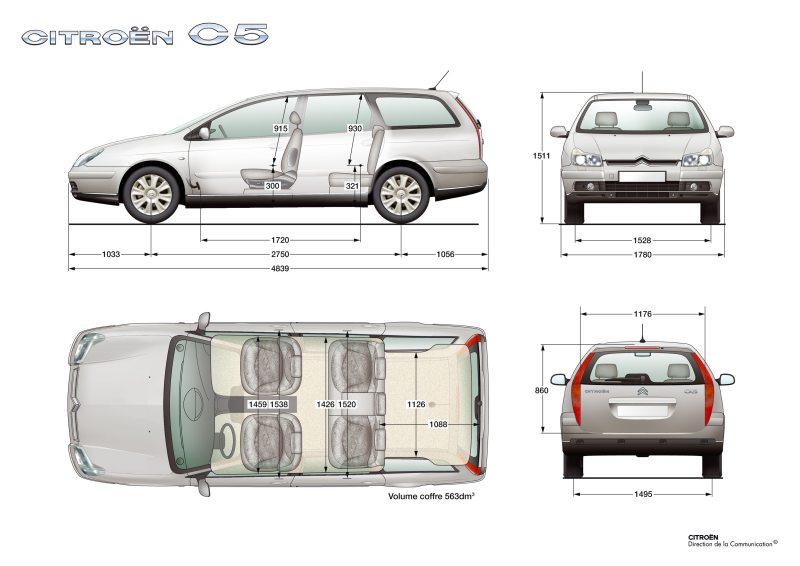
Elbow room is the best
in the segment – 1.52 m at the front and 1.54 m
at the rear –
contributing to the outstanding interior space.
The
combination of a raised driving position and a
useful length of 1.72 m
also make the Citroën C5 one of the most
spacious vehicles in its
category.
The C5 combines record interior space with a
wide range of towage options. The dashboard,
doors and seats all
feature roomy and convenient stowage units. Two
other stowage
compartments are available in the side of the
boot.
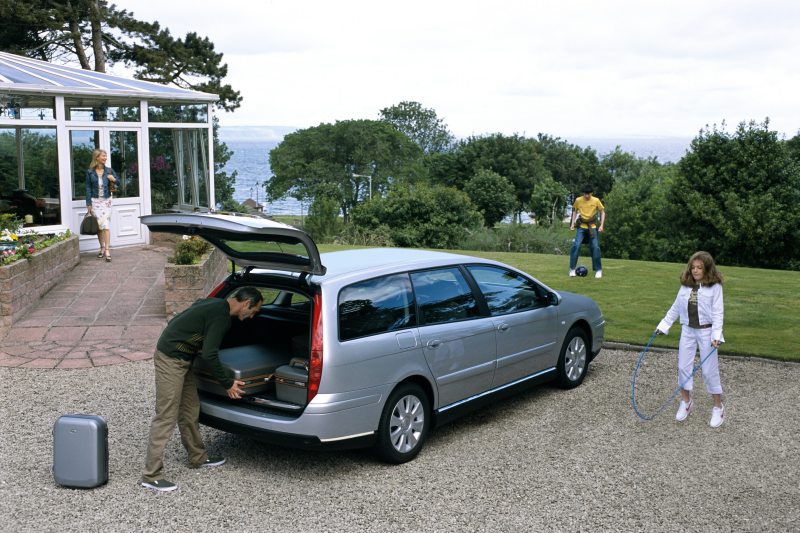
A boot worthy of a high-volume estate
This
exceptional interior space goes hand-in-hand
with generous stowage for
luggage, and easy access, with the rear window
opening independently of
the tailgate. More than 1,170 mm wide, the boot
offers a capacity of
471 litres for the saloon version, and 563
litres for the estate. This
makes the Citroën C5 one of the best estates in
its category, notably
in terms of loading. Moreover, the modular rear
seats increase the
volume to 1,658 litres. The available space may
be increased still
further by removing the rear seat cushions. The
rear seat backs feature
an additional function in the shape of a ski
flap. The structure of the
vehicle ensures that all the loading space can
be used. The boot is
flat and regular in shape with a wide opening
(1,176 mm at the sill).
Maximum head room is 913 mm and 481 mm under the
parcel shelf.
To
make loading easy, the Citroën C5 Estate brings
customers a unique
function: a rear sill of variable height. This
function is available
when the vehicle is stationary and the engine
turned off. The minimum
rear sill height is 493 mm, the normal height
568 mm and the maximum
height 653 mm.
The Citroën C5 makes travelling a more
enjoyable experience
Fully automatic air conditioning
Looking
beyond the upgraded materials, the Citroën C5
features fully automatic
air conditioning. Fitted as standard across the
range, the air
conditioning is available in two versions:
single-zone or two-zone,
with separate temperature and air flow controls.
The
single-zone version offers the comfort of
automatic operation: the
temperature of the passenger compartment is
regulated automatically on
the basis of the temperature selected. As a
result, the temperature
inside the car remains steady, regardless of
weather conditions.
The
second two-zone version satisfies the
requirements of front passengers
in terms of individual comfort. The driver and
passenger can modulate
the temperature and air flow independently.
Complementing
the air conditioning, a sun sensor measures the
strength of the sun’s
rays at the front of the vehicle, on both the
right- and left-hand
sides.
The sun sensor allows the air conditioning to
offset the impact of solar radiation by
automatically varying the
distribution and temperature of the air flow.
These air
conditioning units are equipped with a moisture
sensor to prevent the
passenger compartment from fogging up, and a
pollen filter combined
with a layer of activated carbon to further
isolate the passenger
compartment from certain exterior pollutant
agents.
Along with the automatic air conditioning, the
Citroën C5 offers a heat-reflecting windscreen
on all versions.
JBL acoustics: a high-spec audio system
The
Citroën C5 may be equipped with a radio
featuring a mono-tuner/CD drive
4x10W with six loudspeakers. A dual-tuner
diversity option with an
MP3-compatible CD-drive, offering better RDS
tracking, is also
available on some markets.
The radio systems available on
the Citroën C5 may be coupled with a 6-CD
stacker located under the
front passenger seat. This stacker can also be
controlled by the
NaviDrive system.
The Citroën C5 also offers customers a
system designed by a leading hi-fi acoustics
specialist: JBL. The sound
surrounds all the occupants, giving the
impression of a far larger area
of propagation. The system is in perfect harmony
with the passenger
compartment of the Citroën C5. With total power
of 240 watts, it
comprises eight loudspeakers in eight different
locations.
This
JBL system can be coupled with the MP3 dualtuner
RD4 radio or with the
colour NaviDrive system. This last system groups
a range of functions
on a single panel: audio system (radio and CD),
telephone and
navigation, together with voice synthesis and
recognition capabilities.
This new-generation system was also designed to
provide additional
services: Citroën Emergency, Citroën Local
Assistance, and Citroën
On-Line.
Looking beyond this equipment, which
contributes
to the well-being of both driver and passengers,
Citroën has made the
Citroën C5 a car of exceptional ride comfort, on
a par with its
ambitions.
Road manners and ride comfort for demanding
customers
One of the objectives set out in the
specifications of the Citroën C5 was to
achieve a high level of acoustic comfort and suspension
comfort for a pleasant ride.
Reference acoustic comfort with
laminated side windows
Traditionally
reserved for the next market segment up,
laminated side windows play a
major part in filtering out wind noise and
exterior noise for
high-level acoustic comfort. This security
feature could gain the
Citroën C5 a five-star rating from Thatcham.
The laminated
side window with reinforced acoustic insulation
is made up of two
sheets of glass, assembled using plastic films
of excellent acoustic
properties. This system absorbs sound vibrations
over a wide range of
frequencies, offering an excellent level of
performance in terms of
acoustic insulation.
In the event of accidental breakage
or a break-in, the glass sticks to the plastic
films and remains in
place. The glass and plastic windows are
virtually impenetrable. This
prevents injury in the event of breakage, as
well as providing a
barrier to stop people or objects from being
thrown out of the car in
the event of an accident, and offering efficient
protection against
vandalism and break-ins.
Insulation: a key factor in acoustic
comfort
Associated
with the laminated side windows, other factors
also contribute to the
sound-proofing of the passenger compartment
against exterior air,
engine and water noise.
At the front, the effective
soundproofing under the bonnet filters out noise
rising up from the
engine compartment. The scuttle vent includes a
particularly efficient
absorbent material to limit – for example –
noise rising up through the
air conditioning system.
The passenger compartment too
includes special insulation materials,
particularly the dashboard,
which features a foam whose insulating and
absorbent properties filter
out noise out more effectively. The harnesses
and, more particularly,
the grommets linking the cabin and engine
compartment have been
specially treated for effective insulation.
At the rear,
the use of foam, felt and lining parts,
particularly in the wheel
arches, provides additional acoustic comfort on
the Citroën C5.
Suspension comfort
The
C5 offers unequalled overall suspension comfort,
notably in terms of
damping comfort and road handling, vibrations
and percussion noise.
Development
studies focused on the front suspension. This is
based on a hydraulic
MacPherson-type strut comprising a Sub Frame
fixed at four points to
the structure by means of elastic couplings. The
rear wishbone mounting
shins are specially adapted to ensure ride
refirement.
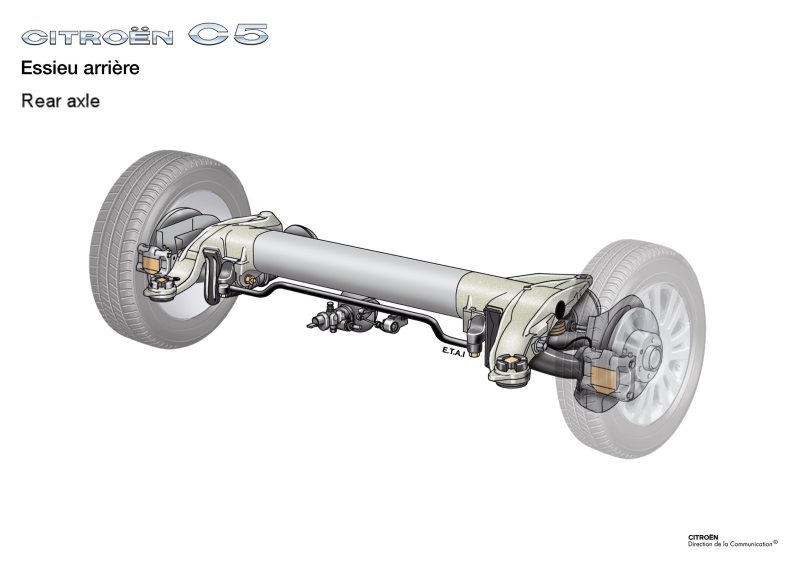
The
rear suspension comprises a cross-member,
cast-iron trailing arms, an
anti-roll bar and four shims whose variable
flexibility effectively
filters out the imperfections of the road
surface.
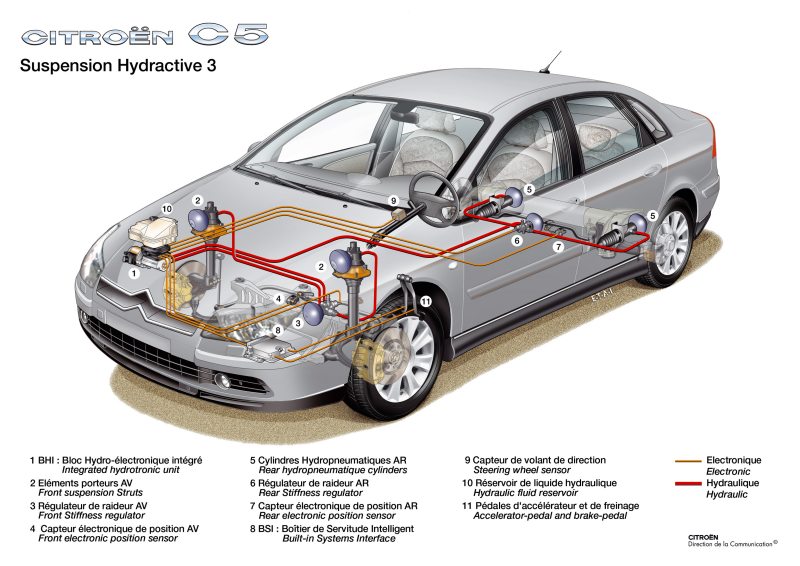
Like
all Citroën’s high-spec saloons and estates, the
Citroën C5 features
hydraulic suspension. Fitted with identical
cylinders (diameter 40 mm)
on the saloon and the estate, this suspension
adapts vehicle height to
speed, driving style and road conditions. Highly
reliable, the
suspension requires no maintenance for five
years or 200,000 km.
The
advanced « hydractive plus »
suspension available with the HDi 136 DPFS
and 3.0i V6 engines adopts a new approach to the
choice of setting. The
emphasis is placed more on soft mode rather than
firm mode, for
increased comfort. The changeover from one
setting to the other depends
on five parameters: acceleration setting, engine
torque, braking,
angular speed steering wheel, and body movement.
These parameters have
been specially adapted to make the Citroën C5 a
reference in its
segment in terms of ride comfort. A sports mode
remains available. This
mode eliminates slight movements of the vehicle
body, adding the final
touch to the car’s remarkable dynamic behaviour
and stability.
The hydraulic suspension also attenuates
steering vibrations on the hydraulic power
steering, which is adapted to each engine.
The
Citroën C5 features two types of variable power
steering. The first
coupled with an electric pump unit, is available
with the 2.0 petrol
and diesel engines. The second is a servotronic
system on the 3.0i V6,
managed by an electronic control unit that uses
a solenoid valve to
adapt the pressure in a continuous system in
line with a control law.
Precise,
flexible and steadfast in all circumstances, the
steering of the
Citroën C5 effectively positions the front wheel
when cornering, giving
the driver an impression of ease and safety.
The Citroën C5 offers strong arguments in the
areas of driving pleasure, comfort and
well-being.
Sixteen-inch tyres for the whole range
!
The
Citroën C5 adopts high-performance tyres as
standard across the range,
with the Michelin Primacy, dimensions: 215/55
R16. These tyres make a
significant contribution to vibration control,
road manners, steering
comfort and braking distances.
©
2004 SA Automobiles Citroën
|