|
||||||||||||||||||||||
|
||||||||||||||||||||||
Ken Smith Interview |
Sadly, Ken passed away on 8th July
2014. RIP Ken. |
By Julian Marsh |
|
|
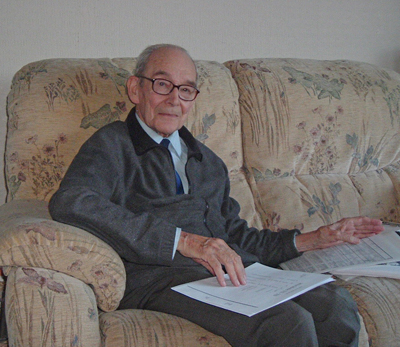
To British Citroën
enthusiasts of a certain age, the name Ken Smith is well known.
It was therefore with great anticipation that I waited for the
September/October 2010 edition of CitroExpert
to arrive since Wouter Jansen had told me he would be publishing an
interview with him. Having read the article, it occurred to me
that British Citroën
fans might also like to read Ken’s reminiscences of an era that many
view as Citroën’s ‘Golden Age’; an era when Citroëns were built in
Britain. |
 |
|
JM: How did you end up working at
Citroën? JM:
In the early sixties, my family went on holiday to Italy in my Dad’s
Slough- built DS. He drove up the Alps in second gear and drove
down in third and fourth with his foot on the brake. After a
while, strange things started to happen – movement of the gear lever
either led to no change of gear or to a refusal to disengage the
clutch; the brakes became spongy, as did the steering. He
called the RAC breakdown service who sent out an Italian mechanic who
said my Father had boiled the LHS2 so he bled the system and sent us on
our way with the advice “Use the same gear to descend that you used to
ascend.” Our return to Britain was plagued by hydraulic leaks. My
Dad took the car to Middleton Motors in Potters Bar who were unable,
despite many attempts, to fix it. Admitting defeat, they
recommended he took it to Slough which was where as a gauche
adolescent, I first met you. You arranged for the seals to be
replaced in the workshop and all was fine thereafter. Now I do
not wish to single out Middleton Motors for particular criticism but I
have often wondered why the expertise was not there at the dealers to
fix anything other than the most straightforward of problems. |
|
 |
Click to see large version of images - will open in new window |
|
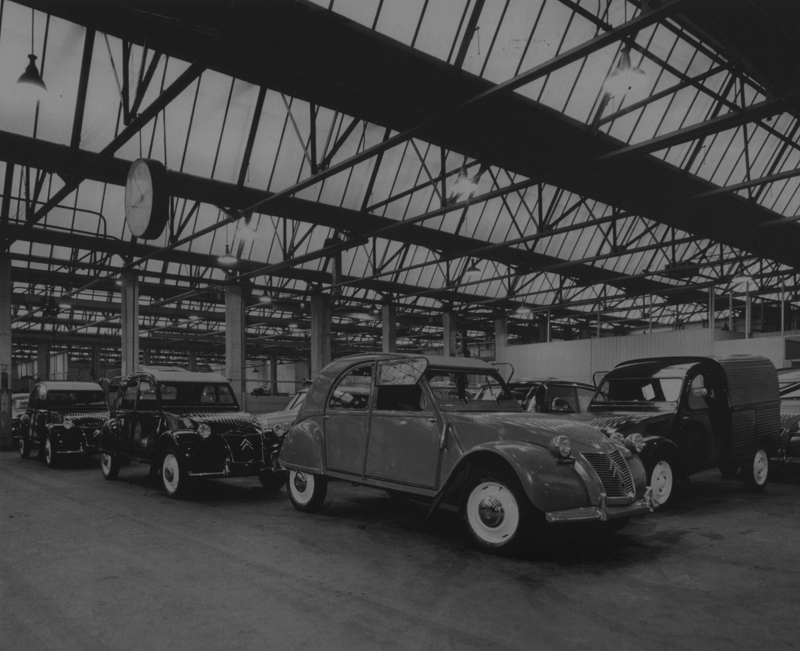
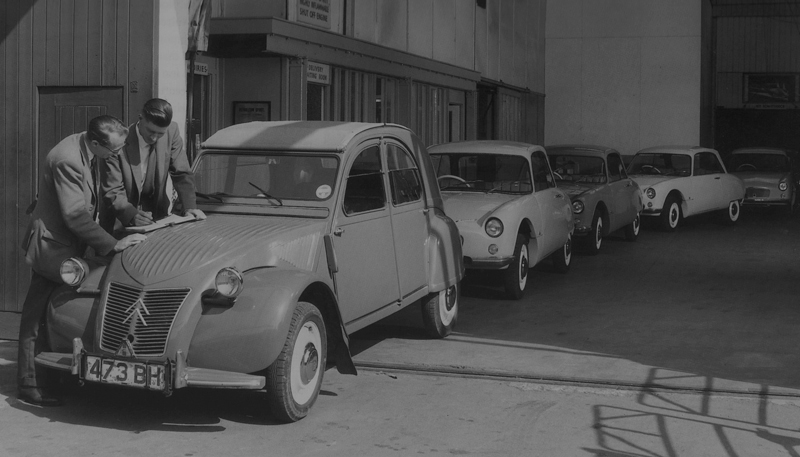
Left 2CV production line at Slough Below cars awaiting collection from the factory |
|
 |
|
|
JM:
Dealer training was but one of many roles you undertook, many of them
simultaneously. In the CitroExpert article, it mentions your
responsibility for ensuring that the British-built cars conformed to
the various Acts and Orders relating to the manufacture of cars at
Slough and also for obtaining National Type Approval for vehicles
imported from 1977. JM:
Slough-built 2CVs differed from the French ones in a number of
respects. The metal bootlid being the most obvious example.
What drove these changes? |
|
 |
 |
|
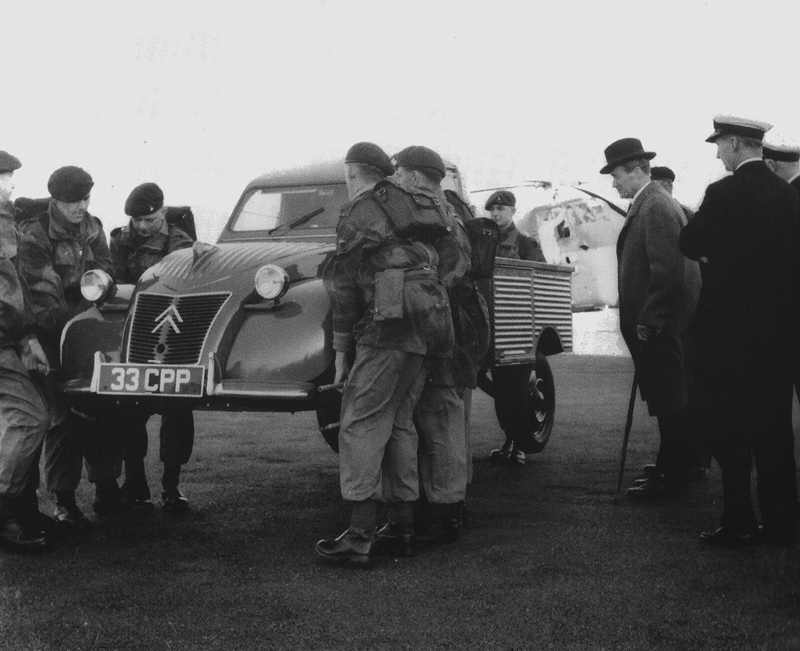
JM: Slough also provided a number of 2CV pickups to the Royal Navy for
use by the Royal Marines on aircraft carriers. JM: Do you know if any of these vehicles
survive? JM: At the recent 2CV GB National,
there were a couple of Louis Barbour-based 4x4 replicas. JM:
The 2CV was not a success in Britain at this stage so the company
decided to dress it up in a new, more fashionable set of clothes and
thus the Bijou was born. JM: I am told that the front screen was actually the rear screen of the Safari. KS: No, it was made specifically for the Bijou. JM:
Staying with the 2CV, after production ceased in 1964 and before
imports started ten years later, I along with many others, imported
2CVs from the Continent. I had a Belgian-built
AZAM6 which suffered major electrical problems and I contacted Slough
to ask if they could let me have a wiring diagram. They sent me a
diagram for a Dyane. I pointed out that this was not very helpful
and they said it was the best they could do. I eventually
obtained the wiring diagram from the Belgian factory. There were
similar problems obtaining service parts such as brake shoes and
clutches from Slough – to the extent that unofficial Citroën
specialists such as Lovekyn flourished since they were able to obtain
the necessary parts. What was the reason for this reluctance to support
privately imported vehicles? JM: Why did it take so long for the
company to start re-importing the 2CV once production at Slough ended? |
|
|
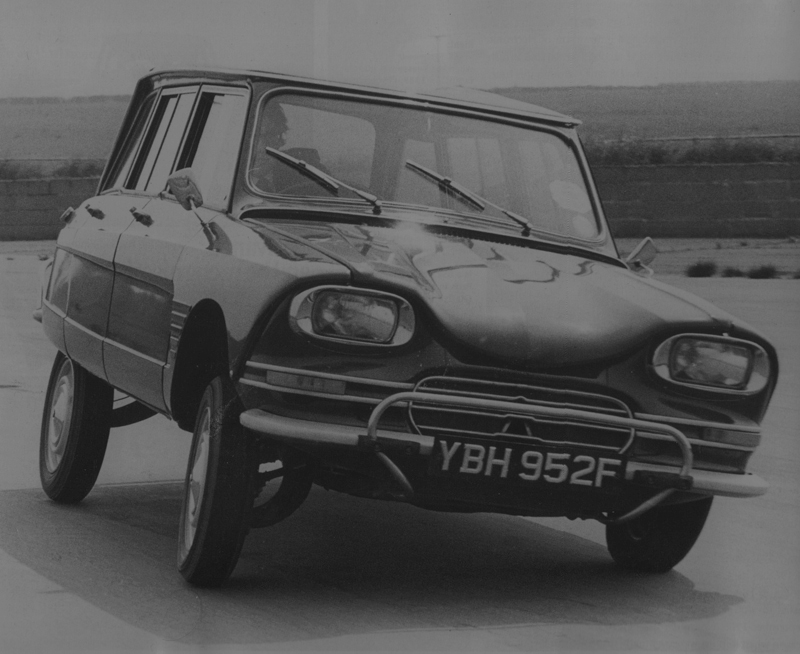
JM: Is there any truth in the story
that the Ami 6 was intended for production at Slough? JM: Was the Ami 6 Service ever sold
here? |
 |
 |
© 2011 Citroënët |













