|
The
C5 is based on an entirely new platform with a
wheelbase of 2,750 mm.
The design meets the most stringent crash-test
requirements and reduces
vibration without increasing weight.
The
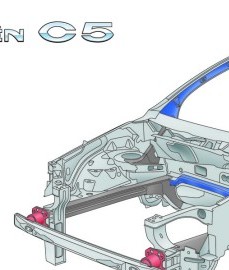
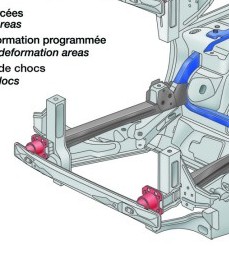
front end comprises two cantrails with built-in
crumple zones, attached
to two shock absorbers, and a cross-beam manufactured
from
very-high-elastic-limit (VHEL) sheet steel. Around the
passenger
compartment, the subframe and the windscreen pillars
are designed to
absorb and dissipate energy towards the rear of the
vehicle. The lower
front pillar trim is made of VHEL sheet steel.
At
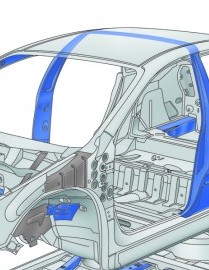
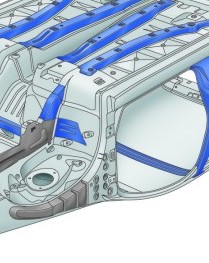
the centre of the vehicle, a roll cage provides
effective protection
against side impact. The roll cage consists of the
central pillars,
reinforced over their entire height, connected at the
top by a roof
cross-member and resting on the side members at their
base.
The floor pan is
essentially flat, providing increased leg room and
comfort for the passenger in the central rear seat.
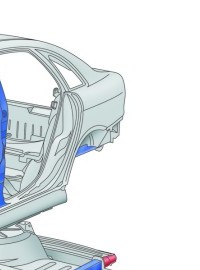
At
the rear, the floor of the boot is recessed to take
the spare wheel.
Like the front end, the rear end is fitted with a
cross-beam and two
shock absorbers.
The
cross-beams and shock absorbers dissipate kinetic
energy in the event
of collisions at high speed, and reduce the cost of
repairs following
minor collisions. Taking into account
the easy
replacement of under-bonnet components, this limits
the repair time for “Thatcham” type collisions (15
km/h).
Stiffness
under static torsion, in which torque of 1,000 Nm is
applied between
the front and rear axles, is 0.8 milliradians.
This
excellent result can be attributed largely to the
reinforced front and
rear pillars, the floor cross-members and the central
roll cage. This
high stiffness contributes to the excellent road
holding of the C5 and
the longevity of the body.
Stiffness
under dynamic torsion is 40 Hz, indicating excellent
vibration
characteristics. Road noise and vibration are
considerably reduced.
The
body shell weighs 293 kg unfinished and 463 kg with
all doors and
opening panels. The total weight of the body shell has
been reduced
notably by adapting the steel thickness and grade to
individual
components, and by making widespread use of aluminium.
For example, the
bonnet is 7 kg lighter than a similar design in
steel.The use of bonded
welding techniques to assembly the body panels to the
substructure has
brought a weight saving of 3 kg while maintaining
excellent stiffness
and endurance. Finally, the use of stamping blanks of
varying
thicknesses avoids the need for local reinforcement,
thereby saving an
additional 1.5 kg.
The
C5 sells with a 12-year anti-corrosion warranty
and a 3-year paintwork
warranty. The result of many years of testing, this
warranty is based
on feedback and extensive in-the-field observation of
vehicle ageing in
everyday use and under static exposure to saline
environments. Overall,
94 % of the body shell by weight (including opening
panels) is
galvanised.
|